Reading and performing a two-minute script in class is an effective and practical way to make learning more engaging. Due to its short length, it is easy to handle, quick to learn, and can be read or performed several times within a single lesson. This is actually its greatest advantage: it can be repeated four or five times with different groups of students.
With each repetition, 5–8 students can be involved in acting out the script. In this way, students not only process the learning material but also deepen their understanding through creative and artistic expression.
Since these short scenes contain dramatic conflicts and emotional elements, the key information of the topic is not only processed intellectually but also through feelings and emotions. As a result, the most important facts—even “quotable” lines—are easier to remember.
In short, this method allows the essential elements of a topic to become vivid, relatable, and memorable.
At first glance, writing a film script may seem difficult, but in reality, both the writing process and the format can be learned quite easily. I will discuss this in a separate article. For now, I simply want to spark interest and describe how I use it:
In my experience, it can be applied to any teaching block or subject. After we have worked through the main topic, created initial drawings, completed the first homework assignments, and listened to student presentations, I write a short script.
I have attached an example script that I created for a 7th-grade astronomy block. It is important that I only write the script once I myself clearly understand the essence of the material, its main message, and its central drama. This is often accompanied by an “aha” moment, and sometimes even a sense of catharsis for the teacher. There is drama in everything. I build the short story around this.
Personally, I always enjoy writing these scripts, because once I grasp the core message of a topic, the story becomes authentic, and the dramatic dialogue or narration almost writes itself.
In the attached three-character script, there is no overwhelming drama, but the subtle elements of the dialogue contain the essential challenges that the main character, Copernicus, will have to face—both internally and externally. The internal drama lies in deciding what path to follow, while the external drama concerns how he can fulfill his vocation despite the spirit of the age.
Students generally enjoy acting, and since they have already learned a great deal about the topic beforehand, they also understand it. A possible homework assignment could be: How would you continue the story? You can also add many other questions related to the topic that you consider important.
Mihály Hevesi
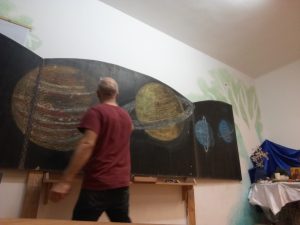
Preapring the astronomy block
Books by the author: